Faces for Ashtami
THIS IS A WORK OF FICTION
On the Tuesday before Panchami, the rain came down Southern Avenue in shiny ropes, and the city behaved as if God had merely spilled tea.
Umbrellas bloomed under tram wires. Autos coughed at the crossing. The pavement tea stall beside the closed sari shop had its usual parliament of damp men: one clerk discussing the collapse of the nation, one retired teacher correcting him, two delivery boys eating ghugni from paper plates, and the tea seller, who had seen enough collapses to know that civilization mostly ended at the cash box.
Dr. Arunava Lahiri stood under the awning of the old Basanti Medical Stores with a cardboard tube tucked under his arm and a blue plastic bag of goat liver in his hand.
The goat liver was not for dinner.
A child in a raincoat shaped like a yellow duck dragged his mother toward the half-finished pandal at Hindustan Park. Bamboo ribs rose above the lane. Men in rolled-up lungis were tying cloth over the structure. A giant clay lion lay on its side beneath tarpaulin, its painted mouth open in an expression of municipal astonishment.
“Dada, liver is leaking,” the medicine-shop boy said.
Arunava looked down. A dark drop had fallen from the bag onto his sandal and was making a small red comma near his big toe.
“Give me another packet.”
“Twenty rupees.”
“For one packet?”
“Puja rate.”
That was the city now. Even plastic had seasonality.
Arunava paid. He was fifty-three, thin, graying, with the scholar’s stoop of a man who had spent too long leaning over things that did not love him back. He had once lectured in evolutionary development at a proper institution with red floors and ceiling fans. Now he ran an unfashionable private laboratory above a wholesale idol-paint supplier in Kalighat, funded by a businessman who wanted “heritage biology” and by his own appetite for one last respectable achievement.
Respectability in Calcutta had become a kind of rented costume. Everyone wore it for inspection and returned it sweat-soaked at night.
His daughter, Mili, called him “Baba” only when she needed money.
His wife, Paromita, had been dead nine years.
That was the wound, if anyone cared to label it. He himself preferred not to. Grief, in Bengali families, was not allowed to remain grief for long. It became advice, blood pressure, property discussion, fish preference, remarriage suggestion, and finally an anecdote told by relatives who had not been present.
A taxi splashed him as it passed.
Inside the cardboard tube, wrapped in brown paper, was a printout of a sequencing map from a private fossil sample sent through Bangkok, then Chennai, then a man named Bappa who smoked beedis beside a crate of plaster Durga heads. Triassic tissue, the seller had claimed. Preserved in mineralized amber. Reptilian. Possibly archosaur-adjacent. Impossible, of course.
Many important things begin by being impossible. That is how fools and pioneers get mistakenly introduced to each other.
Arunava reached the narrow staircase behind the paint shop at six. The smell rose to meet him: varnish, damp plaster, incense, old eggs, and the faint ammonia of cages.
At the top landing, Sulekha was waiting with her arms folded.
She was twenty-seven, his only assistant, a postgraduate who had not cleared a permanent college appointment because permanent appointments had become a family occupation, like temple priesthood or diabetes. She wanted a fellowship abroad. She wanted her father’s cataract surgery paid for. She wanted, more than anything, not to become one of those educated Bengali women who tutored Class Seven children in fractions until their own lives turned into fractions.
“The big one is making sound again,” she said.
“It has no vocal apparatus.”
“Tell it that.”
From the inner room came a wet clicking noise.
Arunava unlocked the lab.
Four tanks lined the wall, each covered with mesh and weights. They had been modified from aquarium glass, then reinforced with iron rods after the first embryo had cracked the corner with its snout before it had even learned to breathe properly.
In the third tank, under a red heat lamp, the creature lifted its head.
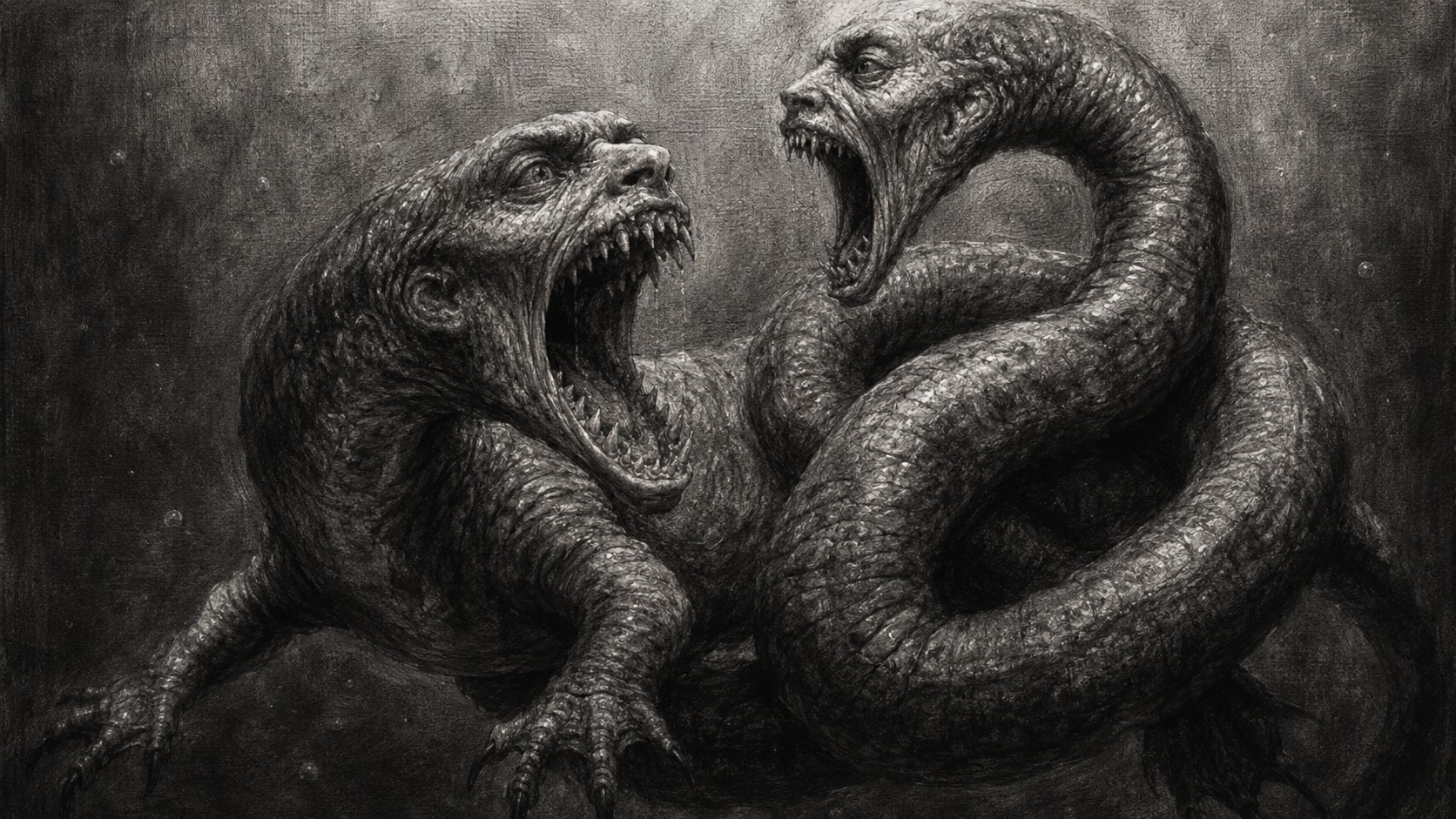
It was the length of a street dog but built wrong for any present century: long back, jointed hind legs, clawed forelimbs, skin like wet betel leaf, and a tail that twitched with the brisk contempt of a lizard. The face, however, was not reptile.
That was Arunava’s achievement and sin.
The face had a blunt brow, a soft mouth, cheek folds, nostrils too humanly placed, and eyes with a dark forward gaze. Not a human face exactly. More like a child’s face remembered by fever.
Mili’s face, at six, when she had fallen asleep over crayons.
Sulekha hated looking at it.
“You fed them?” Arunava asked.
“Twice. Liver and duck eggs. Number Three refused the eggs. Number Two bit the thermometer.”
“What about Number One?”
Sulekha glanced toward the covered tank at the end.
“Still pretending.”
Number One had stopped moving that morning. It had done this before. A dead act. Some instinct older than mammal pity. It lay on its side, little hands curled. Its mouth open slightly.
Arunava went close.
The eyelid flickered.
“See?” Sulekha said. “Drama.”
He should have terminated the trial then. He knew that now, or would know it later, when knowledge arrived with teeth.
Instead he recorded the behavior in a notebook.
The creatures had begun as fragments: fossil proteins, degraded sequences, reconstructed developmental pathways, and modern reptile scaffolds. The human element had entered not from vanity, though vanity had stood outside smoking and waiting to be invited. The face genes were a proof of principle. Facial symmetry. Musculature. Social recognition.
Then, after Paromita’s death anniversary, he had added the instinct cluster.
That phrase sounded clean. It had been anything but clean.
Humans were not noble animals. Human instinct was not kindness poured into flesh. It was recognition, hunger, attachment, envy, imitation, fear of exclusion, attraction to light, delight in crowds, the craving to be seen, the ancient panic of being left outside a circle.
He had wanted the animals to recognize him.
That was all.
A small fatherly crime.
At nine, the power failed.
The heat lamps died. The lab fell into the wet blackness of a Calcutta power cut, a darkness that did not silence the city but made every sound obscene: horns, rainwater, a priest’s microphone testing “Bolo bolo Durga Mai ki,” a pressure cooker downstairs, Sulekha breathing.
“Fuse?” she whispered.
“Load shedding.”
“During Puja preparation? Very good. Progress has reached even darkness.”
He found the emergency lantern and turned it on.
The third tank was empty.
For a moment his mind refused the picture. It showed him the tank with the creature in it, because that was the proper arrangement of the world. Then the light steadied, and he saw the mesh pushed aside, the weight on the floor, and three wet toe marks on his notebook.
Sulekha did not scream. Practical terror has no time for theatre.
“Door,” she said.
The outer door was closed.
From above came the scrape of claws.
The terrace.
Arunava took the iron rod used to stir chemical drums. Sulekha picked up the fire extinguisher. They climbed the stairs slowly.
On the terrace, Puja lights glittered across the neighborhood in premature strings: blue, pink, green, divine electricity bought on credit. Beyond the parapet, bamboo pandals rose like temporary kingdoms. The city was building its annual illusion that the Mother would arrive and notice everyone equally.
Number Three crouched beside the water tank.
Rain slicked its skin. Its face turned toward them.
It smiled.
That was what destroyed Arunava. Not the escape. Not the claws. The smile.
It had learned the human gesture and emptied it of mercy.
“Come,” he said softly.
The creature clicked.
Down in the lane, a group of college boys passed under umbrellas, laughing too loudly, their new kurtas in plastic covers. Pandal-hopping had already begun for those with no patience for official dates. One boy shouted to another about rolls near Maddox Square.
Number Three climbed the parapet.
“No,” Arunava said.
It leapt.
The first death was not reported as a death.
A boy named Subhajit from Behala vanished between Hindustan Park and Ballygunge Place while going with friends to inspect the nearly completed lighting. His friends thought he had left to meet a girl. His mother thought his friends were lying. The police thought both sides were exhausting.
The next morning, Sulekha found his right slipper in the drain beside the pandal.
It had a half-moon bite through the heel.
Arunava held it in his gloved hand and heard, from somewhere inside the bamboo structure, a pleased clicking.
“You have to call someone,” Sulekha said.
“And say what?”
“The truth.”
“The truth needs an office to receive it.”
She stared at him. “A boy is missing.”
“I know.”
“No, sir. You are studying it. That is not the same.”
This was unfair, which made it worse because it was also accurate.
By Sasthi, there were three creatures outside.
Number One had stopped pretending to be dead and broken the side latch. Number Two had followed through the ceiling vent. Number Four remained in the tank, eating, watching, growing.
The city changed around the disappearances without admitting anything had changed. Calcutta has long practice in stepping around holes.
A fruit seller near Rashbehari said a dog-faced child had run across the tram tracks carrying something like a mannequin arm. A decorator in Jodhpur Park claimed thieves were stealing goats. A priest insisted that if people would stop taking selfies in front of unfinished idols, the goddess would stop showing displeasure.
Arunava and Sulekha searched at night.
They found clues too ordinary to frighten anyone properly: smears on bamboo poles; chewed garlands; a torn packet of incense; three missing pigeons; a child’s plastic crown; paan spit covered by another darker stain; bits of liver left near pandals like offerings.
“They return to the lights,” Arunava said.
“Because you gave them human instincts.”
“Because light means gathering. Gathering means food. Or belonging.”
“Same thing in this city,” Sulekha said.
He heard the bitterness and did not answer.
On Saptami afternoon, Mili came to the lab.
She was twenty-two, sharp-faced, tired, wearing jeans and a black kurti. She had Paromita’s eyes and Arunava’s talent for withholding affection until it became unusable.
“I need the documents signed,” she said.
“What documents?”
“For the flat sale. You said after Puja.”
“I said we would discuss after Puja.”
“You discuss everything until it dies of boredom.”
Sulekha was washing instruments behind the curtain and pretending deafness, the most cultivated skill in Bengal after examination coaching.
Mili looked toward the tanks.
“What is that smell?”
“Specimens.”
“You always loved dead things.”
The sentence hit him so exactly that for a moment he could not breathe.
“I am working,” he said.
“So was Ma. Till her chest pain became acidity because you were working.”
There it was. The old accusation, never formally served but always present in the room like unpaid rent. Paromita had called him twice that night. He had been in the lab. He had silenced the phone because a tissue culture had finally responded.
By morning, his wife was dead.
He had not killed her. That legal distinction had kept him alive and made no other improvement.
Mili signed nothing. She left with a slam that woke Number Four.
It rose in the tank.
Its face had changed.
Until then, Arunava had allowed himself the cowardice of saying the resemblance to Mili was accidental. Developmental proximity. Shared mammalian contour. Bereaved imagination.
But Number Four opened its eyes, and Paromita looked back at him.
Not exactly. Not fully. But enough.
“Sulekha,” he said.
She came out, saw his face before she saw the tank, then turned.
“Oh,” she said quietly. “Sir.”
Number Four pressed its palm against the glass.
On the palm, where the skin had split from growth, was a mark like vermilion dragged by a thumb.
Outside, the first dhak started. A drummer practicing somewhere, the sound rolling through lanes and drains and half-painted gods.
That night the monsters began feeding openly.
Not in alleys. Not from shadows. From the festival itself.
At a pandal near Lake Gardens, the lights went off for nine seconds. When they returned, a woman’s husband was gone and she was still holding the end of his uttoriyo. Near Deshapriya Park, a child saw “a didi with a tail” climb the bamboo scaffolding and pull down a man who had been arguing about queue discipline. In Mudiali, a group of pandal-hoppers ran laughing into a lane and came back with one laugh missing.
Calcutta did what it does best. It produced explanations.
Political rivalry. Kidnapping gang. Open drains. Drunk driving. Rumor spread faster than fear because rumor is fear that has learned to entertain itself.
By midnight, Arunava understood the pattern.
The creatures did not attack the isolated. They approached groups. They watched faces lit by bulbs and camera flashes, watched mouths open in admiration, watched families gather before the goddess. Then they chose one person from the edge: the uncle left holding everyone’s shoes, the maid sent to stand outside the VIP queue, the old mother resting near the barricade, the young man walking behind his friends, smiling too late.
Human instinct.
Find the one not securely held by the group.
Eat the one already half-erased.
“Why pandal-hoppers?” Sulekha asked, when he explained this in the lab at two in the morning.
“Because Puja exposes the social animal,” he said. “All the lights, all the clothes, all the proof that you have people to walk with.”
“And those who don’t?”
He looked away.
Number Four clicked softly from the tank.
Sulekha said, “We kill the last one.”
He nodded.
He prepared the injection himself: anesthetic overdose, potassium, acid. It seemed absurdly medical for a creature that had climbed out of prehistory wearing his wife’s almost-face.
When he approached the tank, Number Four did not retreat.
It placed both palms on the glass and made a sound.
Not a word. He was too honest a scientist to call it a word.
But it had the shape of one.
A low, breathy, two-syllable sound.
A-ru.
Sulekha went pale.
“Sir, don’t.”
He lowered the syringe.
The creature touched its own face, then touched the glass, then looked toward the window. Beyond it, Puja lights trembled in rain.
It did not want liver.
It wanted to go out.
It wanted to be seen.
He saw then the full vulgarity of his experiment. He had not put humanity into monsters. He had taken the most humiliating part of being human—the need to be recognized by another face—and installed it inside hunger.
The other three were not merely feeding.
They were joining.
And because they could not be loved, they converted attention into meat.
At dawn on Ashtami, Mili called from a public booth near Gariahat because her purse had been stolen and she had lost her keys. Her voice was frightened in the old childish way she hated revealing.
“Baba, can you come?”
He heard crowds behind her, conch shells, traffic, a loudspeaker singing an Agomoni song with more enthusiasm than tune.
“Stay inside the booth,” he said.
“What?”
“Do not stand at the edge of any crowd.”
“What nonsense?”
“Mili, listen to me.”
But the line crackled, and then there was only the hollow tone of disconnection.
He and Sulekha ran.
The city that morning was dressed for worship and hunt. Women in white saris with red borders moved like flames through wet lanes. Men in fresh panjabis sweated through their collars. Children carried balloons. Volunteers shouted instructions nobody obeyed. The smell of incense, frying luchi, wet flowers, and drains rose into one democratic perfume.
Near Gariahat crossing, the crowd had thickened around a famous pandal shaped like an old zamindar house. Bamboo barricades guided people into loops. Police whistled. Vendors sold plastic swords and glowing crowns. Respectable families pushed forward with the quiet savagery of pilgrims and bus passengers.
Arunava found the public booth empty.
On the floor lay Mili’s broken hair clip.
Blue enamel. A tiny fish.
He picked it up.
Something moved under the pandal platform.
Sulekha gripped his arm. “There.”
Between the bamboo supports, in shadow, a human face looked out.
Not Mili’s. Not Paromita’s.
A boy’s face. Subhajit perhaps. Or an imitation assembled from meals and longing.
The creature smiled.
Then another face appeared beside it.
Then a third.
They were under the pandal, inside the temporary holy house, crawling among electrical cables and cloth. Their tails dragged through fallen flowers. Their hands clutched bits of fabric. Their eyes shone with festival light.
Above them, the goddess stood unfinished in glory, ten arms raised over the crowd.
Mili screamed from the rear service lane.
Arunava ran toward the sound, shoving past a man who cursed him for bad manners even as history opened its jaws under his feet.
Mili was trapped between stacked loudspeaker boxes and a bamboo wall. Number Three crouched before her, head tilted, wearing its child-fever face. It was not attacking yet. It was watching her cry.
“Mili,” Arunava said.
She looked at him with such relief that shame nearly knocked him down.
The creature turned.
For one absurd second, father and monster faced each other like acquaintances at a wedding.
Arunava lifted the bag he had carried from the lab. Goat liver, sedative, blood, all mixed. He threw it into the lane.
Number Three sniffed but did not move.
Of course not.
It had learned better food.
Sulekha came behind it with the fire axe taken from the pandal safety box. She struck its tail.
The creature screamed—a human scream badly folded into reptile lungs—and sprang at her. Arunava drove the iron rod into its side. It twisted, claws tearing his shoulder. Mili threw a brick. A beautiful, ridiculous, Calcutta brick from a broken pavement. It hit the creature’s face.
The face split.
Beneath the human softness was the old Triassic wedge of bone.
Arunava saw the answer then.
Not in the lab. Not in the sequence. In action, as all expensive truths prefer to arrive.
The human face was not the creature.
It was a lure.
The old animal had accepted his gift and used it as bait. Human expression had become coloration, like a flower mimicking a mate, like a parasite wearing the smell of home. The instincts had not civilized the monster. The monster had domesticated the instincts.
“Cover your face!” he shouted.
“What?”
“Don’t look at it!”
He wrapped his wet shawl over his own eyes and charged by sound.
The creature clicked, confused. The spell of recognition had broken. It was only an animal again, angry and close. Sulekha, understanding faster than fear, flung a length of red pandal cloth over its head. Mili pulled the loose electrical cable from a speaker stack and jammed it against the wet iron rod.
The shock threw them all back.
Number Three convulsed, tail hammering the lane. Its human mouth opened and closed. For the first time, it looked like nothing anyone had loved.
From inside the pandal came answering screams.
The other two were moving.
Arunava could have run then with Mili and Sulekha. A decent man would. A sensible man certainly would. Calcutta was full of sensible men who had survived every disaster by leaving five minutes before responsibility arrived.
Instead he stood.
“Mili,” he said, “take Sulekha and go.”
“No.”
“I made them.”
“You always make everything about you.”
It was such a perfectly timed daughterly sentence that he laughed once, sharply, with blood in his mouth.
Then Number Four appeared at the entrance of the service lane.
It had escaped the lab. Of course it had. Perhaps he had left the latch loose. Perhaps it had learned. Perhaps wanting is the best locksmith.
It wore Paromita’s almost-face.
The crowd behind it began to murmur. People saw a wounded woman, perhaps. A performer. A miracle. They lifted their heads toward it, and in that shared upward gaze the creature grew still with pleasure.
Recognition.
Worship.
Food.
Arunava walked toward it with his hands open.
“Baba,” Mili said.
Number Four looked at him.
He did not cover his face. This was his final vanity, or courage; the difference is mostly decided by survivors.
“Paro,” he whispered.
The creature trembled.
For a moment the face worked. The mouth softened. The eyes, forward and dark, seemed almost puzzled by tenderness. It raised one palm and touched Arunava’s cheek.
The claws entered gently.
He put his arms around it.
“Sulekha,” he said.
She understood. She always had, which was why she would leave him one day and live.
She swung the axe into the bamboo support beside the overloaded electrical junction. Mili, crying and furious, kicked the loosened cable into the rainwater pooled at Number Four’s feet.
The light of the pandal went white.
For one second, the goddess, the crowd, the scientist, the monster, and the whole ridiculous electrical optimism of Bengal shone together.
Then the structure went dark.
When the police reports were written, they mentioned faulty wiring, panic, structural collapse, and illegal laboratory animals of uncertain origin. The newspapers preferred “Puja Horror at Gariahat” for one day, then moved to a minister’s remarks about cultural resilience. The missing were counted, miscounted, corrected, and gradually absorbed into the city’s large stomach of unfinished stories.
Sulekha gave no interviews.
Mili signed the flat papers six months later and kept her father’s notebooks in a steel trunk because throwing them away felt too much like forgiveness.
On the last page, under a smear of dried blood and rain, he had written one line.
Not human face gene. Human hunger wearing a face.
The following Puja, at a small pandal in a lane off Kalighat, a child told his grandmother that the lion under the goddess looked wrong. Too soft in the cheeks, he said. Too much like someone waiting to be called by name.
The grandmother told him not to invent nonsense during anjali.
But she moved him closer to the middle of the crowd.